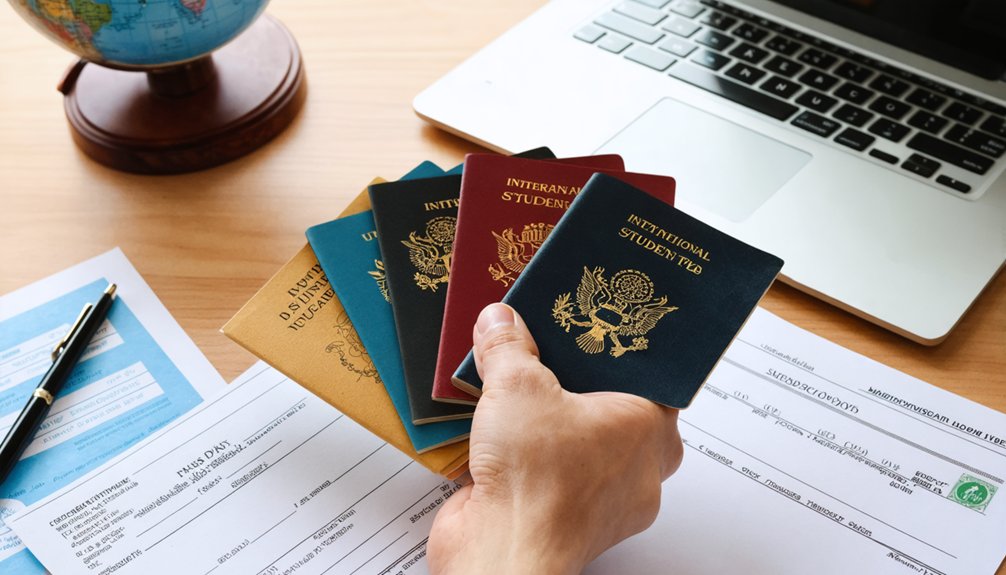

Traversing visas for international students requires understanding specific visa types, including F-1, J-1, and M-1, along with their respective requirements and benefits. F-1 visas cater to full-time degree seekers with opportunities for post-graduation work through Optional Practical Training (OPT). J-1 visas focus on cultural exchange, while M-1 visas are for vocational training with stricter eligibility criteria. Maintaining compliance with immigration regulations is vital. Further perspectives on application steps and maintenance considerations can enhance the visa experience.
Highlights
- Understand the different visa types (F-1, J-1, M-1) and their specific requirements before applying.
- Maintain full-time enrollment and comply with SEVIS regulations to uphold your visa status.
- Before traveling, obtain travel signatures to ensure re-entry eligibility to the US.
- Explore post-study work options like OPT for F-1 students or academic training for J-1 students.
- Stay informed on immigration policies and communicate regularly with your Designated School Official (DSO).
Overview of Visa Types for Students
When considering education abroad, international students typically maneuver several visa options customized to their specific academic goals. The F-1 visa caters to full-time degree-seeking students, allowing easy access to academic enrollment and opportunities like Optional Practical Training (OPT) post-graduation. In contrast, the J-1 visa emphasizes cultural exchange through sponsored programs across various subcategories, requiring non-personal funding sources. Furthermore, F-1 visa holders benefit from no funding source requirements, which can simplify financial planning for their studies.
Understanding these visa options is crucial for international students, as they directly affect aspects of student life, including work capabilities and financial constraints. While F-1 holders may work on-campus without prior approval, J-1 participants face stricter regulations, including the two-year home residence requirement. Ultimately, choosing the right visa enhances the overall educational experience, nurturing a sense of belonging within the academic community, which is essential for international students, as they directly impact aspects of student life.
F-1 Visa Requirements and Benefits
Understanding the requirements and benefits of the F-1 visa is essential for international students pursuing their education in the United States. To qualify, students must enroll in SEVP-certified institutions, maintain full-time status, demonstrate English proficiency, and show financial sufficiency. Visa requirements also include securing an I-20 form, completing the DS-160, paying the SEVIS fee, and preparing necessary documents. The F-1 visa offers benefits such as on-campus employment up to 20 hours per week and eligibility for Optional Practical Training (OPT) to gain work experience in their field of study. Additionally, it provides opportunities for international students to immerse themselves in American culture while maintaining their intent to return to their home countries after their studies. Furthermore, it allows them to broaden their cultural understanding and gain valuable life skills. International travel caution is advised due to unpredictable US immigration policies, which can affect international students when they choose to travel.
J-1 Visa Features and Considerations
The J-1 visa is designed to facilitate cultural and educational exchange for international students and scholars participating in approved programs. This visa comes with specific J-1 requirements, including the need for at least 50-51% of funding from external sources, such as scholarships or grants, rather than personal or family contributions. Applicants must submit Form DS-2019 and comply with SEVIS regulations, with restrictions on employment limited to 20 hours per week on-campus during academic terms. Additionally, Visa restrictions mandate a two-year home residency requirement post-completion of the program, reinforcing the exchange intent. Ensuring proper health insurance coverage for both J-1 and J-2 dependents is also critical, emphasizing the structured nature of this visa category. Furthermore, J-1 visa holders are required to return to their home country after graduation, ensuring that they contribute to their local communities with the skills and knowledge gained during their time in the US. Moreover, mandatory health insurance is required throughout the period of stay, including Academic Training, to ensure the well-being of J-1 participants.
M-1 Visa Guidelines and Limitations
Although the M-1 visa primarily caters to students pursuing vocational and technical training, it comes with strict eligibility criteria and significant limitations that applicants must traverse carefully.
Eligible candidates must be accepted into a SEVP-approved program and demonstrate financial capability to support their tuition and living expenses.
Unlike academic degrees, M-1 visas focus exclusively on vocational training and technical studies, precluding attendance at universities or involvement in liberal arts courses.
Additionally, rigorous attendance requirements mandate full-time enrollment, with no allowance for English language training.
Work authorization is limited, barring on/off-campus employment and permitting only restricted optional practical training.
Post-program, students face strict departure obligations, emphasizing the importance of careful planning throughout their M-1 visa path.
Application Steps for Visa Approval
Traversing the visa application process requires careful attention to several key steps following the M-1 visa guidelines. First, obtaining the I-20 form from SEVP-certified institutions serves as formal proof of enrollment and study plans.
Next, paying the mandatory SEVIS I-901 fee guarantees compliance with entry requirements; a fee receipt is essential for visa interviews. Completing the DS-160 form online involves providing personal information and social media profiles for vetting.
Scheduling the visa interview through embassy websites requires documents such as the I-20, SEVIS receipt, and financial proofs. Additionally, having the SEVIS Fee Payment Receipt printed and ready for your interview is critical in demonstrating compliance with U.S. Department of Homeland Security regulations. It is also important to note that F-1 visa applicants must provide proof of financial support, ensuring they can sustain themselves while studying in the U.S. Finally, preparing for U.S. entry involves carrying the original I-20 and valid passport, guaranteeing all documentation aligns with entry requirements to facilitate a smooth shift into academic life.
Post-Study Work Options for F-1 and J-1 Students
Post-study work options for F-1 and J-1 students play a crucial role in their shift from academic life to professional careers in the United States. F-1 students can apply for Optional Practical Training (OPT), allowing them to work for up to 12 months after graduation, with the possibility of extending this period to 36 months for those in STEM fields through OPT extensions. In contrast, J-1 students primarily engage in on-campus work or authorized academic training. While J-1 students have unique restrictions, including a two-year home residency requirement, they can still pursue valuable training opportunities. Additionally, both visa types support international students in gaining hands-on experience through direct work opportunities related to their fields of study. Both visa types facilitate critical conversions into the workforce, fostering professional growth and integration within American society for international students, which is essential for their development, and both visa types are also essential, facilitate a smooth passage, and nurture valuable relationships and a prized experience. The OPT extension allows STEM graduates to expand their work experience in the US, which enhances their employability in global job markets.
Important Considerations for Visa Maintenance
Maintaining visa status is essential for international students to guarantee their ability to study and work in the United States. Compliance with immigration rules is pivotal; students must enroll in a minimum of 12 credits per semester and maintain good academic standing. Withdrawal from classes without prior DSO approval can jeopardize visa compliance. Failing to maintain full-time enrollment can result in a loss of F-1 status, making it crucial for students to stay informed of their enrollment requirements.
Keeping SEVIS records up to date is essential, including annual validations and reporting changes in personal information. Upon arriving in the U.S., timely immigration procedures and communication with the DSO guarantee proper registration and compliance with visa regulations. Additionally, obtaining travel signatures before departing helps secure re-entry eligibility. F-1 and J-1 students must maintain lawful nonimmigrant status to avoid serious issues with immigration.
Ultimately, proactive engagement with immigration policies promotes a supportive academic environment for international students.
Conclusion
In brief, traversing the intricacies of student visas is essential for international students pursuing education in another country. Understanding the differences between the F-1, J-1, and M-1 visa categories, along with their respective requirements and benefits, is vital for compliance and success. Additionally, awareness of post-study work options and the importance of maintaining visa status can substantially enhance the overall experience abroad. By staying informed, students can successfully manage their visa path and achieve their educational goals.
References
- https://shorelight.com/student-stories/us-student-visa-2025-how-to-apply-visa-types-requirements-fees-and-more/
- https://www.educations.com/countries/usa
- https://timesconsultant.com/blog/guide-to-usa-student-visas/
- https://blog.remitly.com/immigration/types-international-student-visas-in-us/
- https://travel.state.gov/content/travel/en/us-visas/study/student-visa.html
- https://www.hio.harvard.edu/student-visa-process
- https://iss.wisc.edu/f-1-j-1-comparison-2/
- https://cge.fsu.edu/international-students/current-students/visa-types-study
- https://www.rochester.edu/iso/new-students/student-visa-categories/
- https://www.usa.gov/student-visa